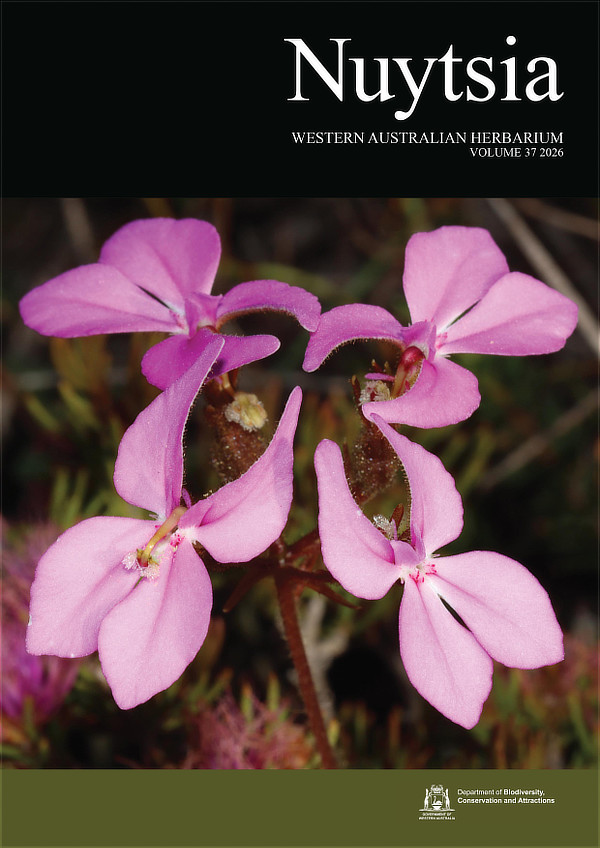
The Western Australian Herbarium’s collections management system, WAHerb, and DBCA’s flora taxonomic names application, WACensus, have been set to read-only mode since 1 October 2025. Recent taxonomic changes are not currently being reflected in Florabase, herbarium collections, or the census. The project team is now conducting testing of the migrated data, and a further update will be provided by the end of the financial year (1 July). Please reach out to us if you have any questions or concerns.
The notice period
started at 9:45 am on Friday, 12 December 2025 +08:00 and will end at 12:00 pm on Wednesday, 1 July 2026 +08:00.
This taxonomic review of Stylidium sect. Junceae Mildbr. recognises eight species endemic to south-western Western Australia and presents a new circumscription for S. junceum R.Br., the original description of which was based on a mixed gathering comprising three distinct taxa. A lectotype is designated in order to fix the application of the name S. junceum to one of these, a species with a diminutive habit, pale creamy yellow to apricot-pink corolla lobes, and a column morphology that is unique within the genus. A neotype is designated for S. junceum subsp. brevius (E.Pritz.) Carlquist, which is not recognised as distinct. Stylidium scariosum DC. is reinstated and S. hesperium Wege, S. hygrophilum Wege, S. paludicola Wege and S. thryonides Wege described as new. Revised descriptions are provided for S. squamosotuberosum Carlquist and S. laciniatum C.A.Gardner, with S. junceum var. volubile F.Muell. lectotypified and placed into synonymy under the latter species. Descriptions, distribution maps, illustrations and photographs are supplied for each species, and an identification key provided. Stylidium hygrophilum has a highly localised distribution on the Blackwood Plateau south of Busselton and may warrant listing as Threatened. Stylidium paludicola, a species confined to swamps on the Swan Coastal Plain, is also listed as being of conservation concern, with targeted surveys required to better understand its conservation status.
A new subspecies of the threatened monocalypt Eucalyptus insularis (Myrtaceae) from Western Australia
NICOLLE, D.,BROOKER, M.I.H. AND FRENCH, M.E., Nuytsia24: 249–253 (2014)
Two subspecies are here recognised in the geographically rare and taxonomically isolated Eucalyptus insularis Brooker. Eucalyptus insularis subsp. insularis is known only from North Twin Peak Island in the Recherche Archipelago, about 90 km east-south-east of Esperance. Eucalyptus insularis subsp. continentalis D.Nicolle & Brooker subsp. nov. is known only from several small populations near Cape Le Grand on the mainland, about 25 km south-east of Esperance, and differs from the type subspecies in its low shrubby habit, smaller adult leaves with obscure tertiary venation and irregularly-shaped oil glands, more strongly pendulous inflorescences, and its generally smaller buds and fruits.
Brachyloma stenolobum (Ericaceae: Styphelioideae: Styphelieae), a new, white-flowered species for Western Australia
HISLOP, M. AND CRANFIELD, R.J., Nuytsia24: 255–261 (2014)
A new member of Brachyloma Sond. sect. Lissanthoides Benth. is described and illustrated. Two keys are presented: an interim key to the Western Australian species of Brachyloma, and an Australia-wide key to the species of sect. Lissanthoides. The presence of two lineages in the genus, distinguished by molecular phylogenetics and morphology, is discussed, and the case for future elevation of sect. Lissanthoides to generic status is examined.
An update to the taxonomy of some Western Australian genera of Myrtaceae tribe Chamelaucieae. 3. Thryptomene
Fifteen new species of Thryptomene Endl. that belong to sect. Astraea Stapf s. lat. are described: T. caduca Rye & Trudgen, T. calcicola Rye, T. dampieri Rye, T. globifera Rye, T. hubbardii Rye & Trudgen, T. nitida Rye & Trudgen, T. orbiculata Rye & Trudgen, T. pinifolia Rye & Trudgen, T. podantha Rye & Trudgen, T. repens Rye & Trudgen, T. shirleyae Rye, T. spicata Rye & Trudgen, T. stapfii Rye & Trudgen, T. velutina Rye & Trudgen and T. wannooensis Rye. A key is supplied for sect. Astraea and line illustrations or images for seven of the new taxa. Thryptomene urceolaris F.Muell. is selected as the lectotype of T. sect. Thryptocalpe Stapf. Lectotypes are also selected for T. stenophylla F.Muell. and for Scholtzia decandra F.Muell., which is a synonym of T. saxicola (A.Cunn. ex Hook.) Schauer. Most of the new taxa are conservation-listed. Species or species groups needing further study are noted.
Amanita drummondii and A. quenda (Basidiomycota), two new species from Western Australia, and an expanded description of A. walpolei
DAVISON, E.M.,GIUSTINIANO, D.,MCGURK, L.E.,SYME, K. AND ROBINSON, R.M., Nuytsia25: 1–13 (2015)
Three species of Amanita Pers. are documented from Western Australia. Amanita drummondii E.M.Davison is described from the south-west region; it appears to be widespread but infrequent. Amanita quenda E.M.Davison is described from the Perth Metropolitan area. Amanita walpolei O.K.Mill. is redescribed to include additional collections, drawing attention to the presence of clamp connections in all tissues. A BLASTn search has shown that there are no exact matches of the nuclear ribosomal internal transcribed spacer (ITS) region of each species with those in GenBank.
Synostemon hamersleyensis (Phyllanthaceae), a new species endemic to the Pilbara, Western Australia
TELFORD, I.R.H. AND NAAYKENS, J., Nuytsia25: 31–37 (2015)
Synostemon hamersleyensis I.Telford & Naaykens (Phyllanthaceae), morphologically similar to but distinct from Sauropus aphyllus J.T.Hunter & J.J.Bruhl, is named as new and its habitat, distribution and conservation status are discussed. The new species is endemic to ironstone formations of the Hamersley Range in the Pilbara, central Western Australia.
New taxa of Caladenia (Orchidaceae) from south-west Western Australia
BROWN, A.P. AND BROCKMAN, G., Nuytsia25: 45–123 (2015)
Eleven new species (Caladenia ambusta A.P.Br. & G.Brockman, C. bigeminata A.P.Br. & G.Brockman, C. leucochila A.P.Br., R.Phillips & G.Brockman, C. erythronema A.P.Br. & G.Brockman, C. fluvialis A.P.Br. & G.Brockman, C. hopperiana A.P.Br. & G.Brockman, C. perangusta A.P.Br. & G.Brockman, C. pluvialis A.P.Br. & G.Brockman, C. straminichila A.P.Br. & G.Brockman, C. swartsiorum A.P.Br. & G.Brockman and C. validinervia Hopper & A.P.Br. ex A.P.Br. & G.Brockman) and six new subspecies (C. attingens Hopper & A.P.Br. subsp. effusa A.P.Br. & G.Brockman, C. denticulata Lindl. subsp. albicans A.P.Br. & G.Brockman, C. denticulata subsp. rubella A.P.Br. & G.Brockman, C. longicauda Lindl. subsp. extrema A.P.Br. & G.Brockman, C. longicauda subsp. insularis Hopper & A.P.Br. ex A.P.Br. & G.Brockman and C. longicauda subsp. minima A.P.Br. & G.Brockman) are described and illustrated and their relationships with related taxa discussed. We discuss the conservation status of rare taxa.
A new species of Angianthus (Asteraceae: Asteroideae: Gnaphalieae) from the south-west of Western Australia
LYONS, M.N. AND KEIGHERY, G.J., Nuytsia25: 125–129 (2015)
The new species Angianthus globuliformis M.Lyons & Keighery (Asteraceae: Gnaphalieae) is described from gypsum dunes of the Western Australian agricultural zone.
Reinstatement of Ericomyrtus (Myrtaceae: Chamelaucieae), with three new combinations
The south-western Australian genus Ericomyrtus Turcz. is reinstated as a small genus comprising the type species E. drummondii Turcz., and three species transferred into the genus as E. parvifolia (Turcz.) Rye, E. serpyllifolia (Turcz.) Rye and E. tenuior (Ewart) Rye. A lectotype is selected for the base name of the last of those species, Baeckea crispiflora var. tenuior Ewart. It appears that the genus has a tetraploid base number of x = 22. Maps, descriptions and a key are provided for the four named members of the genus.
Dipteracanthus chichesterensis (Acanthaceae: Ruellieae), a new geographically and edaphically restricted species from the Pilbara bioregion of Western Australia
TRUDGEN, MALCOLM E. AND DE KOCK, P.-L., Nuytsia25: 161–170 (2015)
Dipteracanthus chichesterensis Trudgen & de Kock is described as a new species of Acanthaceae (tribe Ruellieae Dumort.) restricted to the Chichester Plateau in the Pilbara bioregion of Western Australia. The new species is known from five localities and is considered poorly known and of conservation significance. It is most closely related to D. australasicus F.Muell., differing in stem and leaf indumentum, pollen ornamentation and seed characteristics. A distribution map, photographs and a key to Dipteracanthus Nees taxa currently recognised in Western Australia are provided.
A revision of species from the tribe Lasiopetaleae (Byttnerioideae: Malvaceae) with rostrate anthers
SHEPHERD, K.A. AND WILKINS, C.F., Nuytsia25: 171–189 (2015)
An informal group of species within the tribe Lasiopetaleae Gay, characterised by a lack of stipules and distinctive, rostrate anthers, are revised and included in Lasiopetalum Sm. Revised descriptions are provided for the reinstated L. laxiflorum (Benth.) F.Muell. and newly elevated subspecies of L. glutinosum (Lindl.) F.Muell. (L. glutinosum subsp. glutinosum and L. glutinosum subsp. latifolium (Benth.) K.A.Sheph. & C.F.Wilkins). Three new species of conservation concern are recognised (L. cenobium K.A.Sheph. & C.F.Wilkins, L. trichantherum K.A.Sheph. & C.F.Wilkins and L. venustum K.A.Sheph. & C.F.Wilkins). A distribution map, images and a key to the group are included.
Stylidium miscellany II: typification of some Sonder names and the description of a new subspecies of S. uniflorum
A full synonymy is presented for S. affine Sond. to include S. affine var. minus E.Pritz., a name previously treated as a synonym of S. caricifolium Lindl. Lectotypes are selected for four species described by Otto Sonder, namely S. lineatum Sond., S. pubigerum Sond., S. rupestre Sond. and S. uniflorum Sond. Stylidium rupestre f. abbreviatum Mildbr., S. rupestre f. congestum Mildbr., S. rupestre f. uniflorum Mildbr. and S. glaucum var. brownei DC. are formally placed into synonymy under S. rupestre, with lectotypes designated for S. rupestre f. abbreviatum and S. glaucum var. brownei. Revised descriptions are provided for S. rupestre and S. uniflorum, and S. uniflorum subsp. extensum Wege is newly described. Putative hybrids between both subspecies of S. uniflorum and S. leptophyllum DC. are recorded.
Recognition of Hysterobaeckea as a genus of Myrtaceae tribe Chamelaucieae
Baeckea behrii Schltdl. is selected as the lectotype for B. subg. Hysterobaeckea Nied., which is raised to the generic level as Hysterobaeckea (Nied.) Rye. New combinations are made for the three named species that belong to the genus as now defined, and a lectotype is selected for one of those species, B. ochropetala F.Muell. The three new combinations are H. behrii (Schltdl.) Rye, H. ochropetala (F.Muell.) Rye and H. tuberculata (Trudgen) Rye. The distinguishing characters of the genus are outlined and a generic key given for the group to which it belongs.
A revision of the south-western Australian genus Babingtonia (Myrtaceae: Chamelaucieae)
In this revision of Babingtonia Lindl., 11 species are recognised, all endemic to the south-west of Western Australia. Previously, the type species B. camphorosmae (Endl.) Lindl. was the only Western Australian species housed as a Babingtonia. The new combination B. grandiflora (Benth.) Rye is made, and nine new taxa are named: B. cherticola Rye & Trudgen, B. delicata Rye & Trudgen, B. erecta Rye & Trudgen, B. fascifolia Rye, B. maleyae Rye & Trudgen, B. minutifolia Rye & Trudgen, B. pelloeae Rye & Trudgen, B. triandra Rye & Hislop and B. urbana Rye. A key is given and some of the taxa are illustrated. Most have conservation priority.
Additional taxa of Indigofera (Fabaceae: Indigofereae) from the Eremaean Botanical Province, Western Australia
WILSON, PETER G. AND ROWE, R., Nuytsia25: 251–284 (2015)
Twelve new species of Indigofera L. are described from the Eremaean Botanical Province: I. chamaeclada Peter G.Wilson & Rowe, I. cuspidata Peter G.Wilson & Rowe, I. decipiens Peter G.Wilson & Rowe, I. eriophylla Peter G.Wilson & Rowe, I. fractiflexa Peter G.Wilson & Rowe, I. gilesii Peter G.Wilson & Rowe, I. kingiana Peter G.Wilson & Rowe, I. melanosticta Peter G.Wilson & Rowe, I. occidentalis Peter G.Wilson & Rowe, I. oraria Peter G.Wilson & Rowe, I. roseola Peter G.Wilson & Rowe and I. warburtonensis Peter G.Wilson & Rowe. A lectotype is designated for the name I. boviperda Morrison and three new subspecies, I. boviperda subsp. eremaea Peter G.Wilson & Rowe, I. fractiflexa subsp. augustensis Peter G.Wilson & Rowe and I. chamaeclada subsp. pubens Peter G.Wilson & Rowe, are recognised.
A revision of the Hibbertia hypericoides species group (Dilleniaceae)
THIELE, K.R. AND COCKERTON, G.T.B., Nuytsia25: 285–300 (2015)
The Hibbertia hypericoides (DC.) Benth. species group comprises four species endemic in Western Australia. Hibbertia hypericoides is the most widespread species of Hibbertia Andrews in Western Australia, and exhibits significant and complex variation. The new subspecies H. hypericoides subsp. septentrionalis K.R.Thiele & Cockerton is described to accommodate a long-recognised form that occurs in the northern part of its range. The new species H. cockertoniana K.R.Thiele, previously included in H. hypericoides, is described. Descriptions are also provided for H. hypericoides subsp. hypericoides, H. silvestris Diels and H. furfuracea (R.Br. ex DC.) Benth., the other taxa in the group.
Hibbertia paranthera (Dilleniaceae), a remarkable new species from the Prince Regent River in Western Australia
A distinctive and remarkable new species in Hibbertia Andrew subgen. Pachynema (R.Br. ex DC.) J.W.Horn is described and illustrated. Hibbertia paranthera K.R.Thiele sp. nov. differs from all other species in subgen. Pachynema (and in the whole of Hibbertia) in having an androecium reduced to two large stamens, and a corolla of three petals. The new species is currently known from two populations c. 30 km apart in sandstone habitats in a remote area in Prince Regent National Park, between the Prince Regent River and Prince Frederick Harbour.
A taxonomic revision of the Stylidium brunonianum alliance (sect. Saxifragoidea: Stylidiaceae)
A morphological assessment of Stylidium brunonianum Benth. and its allies recognises eight taxa, all of which are endemic to the south-west of Western Australia. Following examination of type material and field work, a narrower circumscription of S. brunonianum is presented, S. tenue Sond. is reinstated and the following five taxa are newly described: S. araeophyllum Wege, S. neurophyllum Wege, S. purpureum Wege, S. spiciforme Wege and S. tenue subsp. majusculum Wege. A revised description is provided for S. lowrieanum Carlquist, a conservation-listed species from the Leeuwen-Naturaliste Ridge. Lectotypes are selected for S. brunonianum, S. tenue and S. brunonianum var. minor Benth., with the varietal name newly placed into synonymy under S. tenue. A lectotype is also designated for the name S. striatum Lindl. var. glaucum Benth. (based on collections of S. lowrieanum, S. neurophyllum, S. bellum Wege and S. rosulatum Wege) to fix its application as a synonym of S. rosulatum. A dichotomous key to the S. brunonianum alliance is provided along with photographs of key features and distribution maps.
Fifty new species of vascular plants from Western Australia—celebrating fifty years of the Western Australian Botanic Garden at Kings Park
This paper introduces a special issue of Nuytsia containing seven collaborative papers naming 50 new species of Western Australian vascular plants. It has been compiled to celebrate the 50th anniversary of the opening of the Western Australian Botanic Garden at Kings Park. Several species are named after former Kings Park staff to honour their contributions to botany in Western Australia, including one that occurs naturally in the Kings Park bushland and is named after one of the designers of the Botanic Garden. Field research by Kings Park staff across Western Australia, including the rediscovery of Auranticarpa resinosa (Domin) L.W.Cayzer, Crisp & I.Telford, missing for 180 years, is documented.
Twenty-seven new species of vascular plants from Western Australia
BARRETT, R.L. AND BARRETT, M.D., Nuytsia26: 21–87 (2015)
Twenty-seven new species are described from Western Australia. Bossiaea arenitensis R.L.Barrett, B. zarae R.L.Barrett (Fabaceae), Commelina roensis M.D.Barrett & R.L.Barrett (Commelinaceae), Crinum joesmithii M.D.Barrett & R.L.Barrett (Amaryllidaceae), Eriocaulon rivicola G.J.Leach, M.D.Barrett & R.L.Barrett (Eriocaulaceae), Glycine remota M.D.Barrett & R.L.Barrett (Fabaceae), Hybanthus bennettiae R.L.Barrett (Violaceae), Mitrasacme thedae M.D.Barrett & R.L.Barrett (Loganiaceae), Nymphoides astoniae M.D.Barrett & R.L.Barrett (Menyanthaceae), Proiphys kimberleyensis M.D.Barrett & R.L.Barrett (Amaryllidaceae), Schoenus thedae M.D.Barrett & R.L.Barrett (Cyperaceae), Trachymene pavimentum M.D.Barrett & R.L.Barrett (Araliaceae), Tribulopis marliesiae R.L.Barrett (Zygophyllaceae), Triodia celsa M.D.Barrett and T. diantha M.D.Barrett (Poaceae) are described from the Kimberley region. Aphyllodium beardii R.L.Barrett (Fabaceae) is described from the Great Sandy Desert and Triodia basitricha M.D.Barrett is described from the Pilbara region. Calectasia demarzii R.L.Barrett, C. elegans R.L.Barrett, C. jubilaea R.L.Barrett, C. valida R.L.Barrett (Dasypogonaceae), Caustis deserti R.L.Barrett, C. gigas Meney & K.W.Dixon ex R.L.Barrett, Lepidosperma fairallianum R.L.Barrett, L. hopperi R.L.Barrett, L. oldhamii R.L.Barrett (Cyperaceae) and Poranthera asybosca R.L.Barrett (Phyllanthaceae) are described from the south-west of Western Australia. All new species are illustrated and their conservation status assessed.