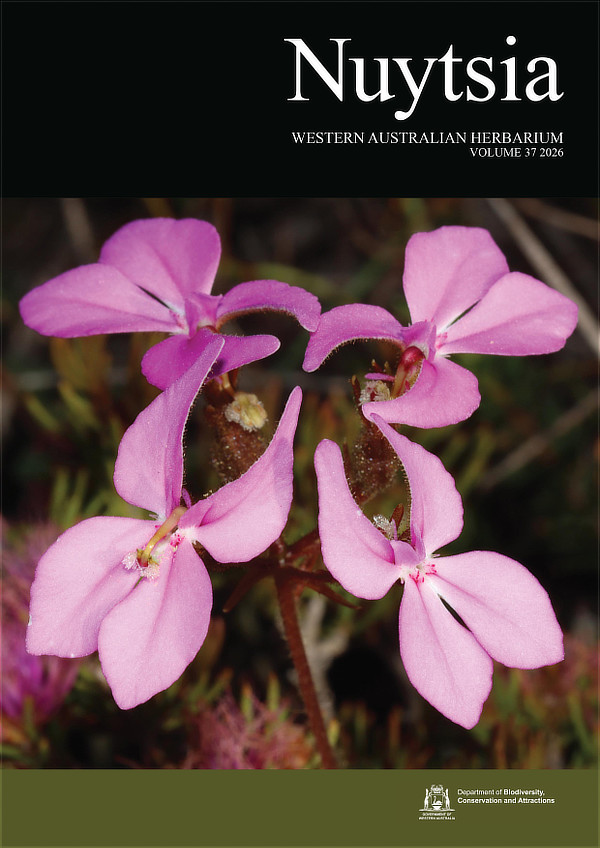
The Western Australian Herbarium’s collections management system, WAHerb, and DBCA’s flora taxonomic names application, WACensus, have been set to read-only mode since 1 October 2025. Recent taxonomic changes are not currently being reflected in Florabase, herbarium collections, or the census. The project team is now conducting testing of the migrated data, and a further update will be provided by the end of the financial year (1 July). Please reach out to us if you have any questions or concerns.
The notice period
started at 9:45 am on Friday, 12 December 2025 +08:00 and will end at 12:00 pm on Wednesday, 1 July 2026 +08:00.
A new subspecies, Johnsonia pubescens subsp. cygnorum Keighery, is described from the Swan Coastal Plain, in south-western Australia. New populations are listed for Johnsonia inconspicua Keighery, including one very disjunct population with a distinct variant; this species was previously known only from the type collection.
Acacia stellaticeps (Fabaceae: Mimosoideae), a new species from the Pilbara, Western Australia, to Tanami, Northern Territory
KODELA, P.G.,TINDALE, MARY D. AND KEITH, D.A., Nuytsia13 (3): 483–486 (2001)
Acacia stellaticeps Kodela, Tindale & D. Keith, a new species of Acacia section Plurinerves (Benth.) Maiden & Betche from Western Australia and the Northern Territory, is described and illustrated.
Notes on Eucalyptus series Orbifoliae (Myrtaceae) including a new species from central Australia
A key and distribution map for all taxa of Eucalyptus ser. Orbifoliae Brooker & Hopper are provided. Eucalyptus minniritchi Nicolle is described to accommodate populations of mallees in central Australia previously referred to as E. orbifolia F. Muell. or E. websteriana Maiden and related to both. The new species differs from E. orbifolia in the smaller buds with a short hemispherical operculum, the smaller and narrower adult leaves and the generally smaller, hemispherical fruits and differs from E. websteriana in the consistently and strongly pruinose adult parts and generally coarser leaves, peduncles, pedicels, buds and fruits. E. lata L.A.S. Johnson & K.D. Hill, a species recently described to accommodate what is here recognized to be typical E. orbifolia, is synonymised with that earlier named species. The status of E. educta L.A.S. Johnson & K.D. Hill and its relationship to E. orbifolia is discussed.
A taxonomic update of Stenanthemum (Rhamnaceae: Pomaderreae) in Western Australia
A generic description of Stenanthemum Reissek is given, together with a key and distribution maps for the 23 species occurring in Western Australia. Stenanthemum leucophractum (Schledl.) Reissek is nominated as the type species of the genus. Three new species from south-western Australia, Stenanthemum liberum Rye, S. patens Rye and S. sublineare Rye, are described and illustrated, and new seed measurements are given for S. cristatum Rye. All of the new species have conservation priority.
A taxonomic revision of Thryptomene section Thryptomene (Myrtaceae)
RYE, B.L. AND TRUDGEN, MALCOLM E., Nuytsia13 (3): 509–528 (2001)
A revision of Thryptomene Endl. sect. Thryptomene is presented covering the nine species now included, with distribution maps and a key for all species and illustrations of selected taxa. Five new species and a new subspecies are described. These are Thryptomene australis subsp. brachyandra Rye & Trudgen, T. costata Rye & Trudgen, T. eremaea Rye & Trudgen, T. duplicata Rye & Trudgen, T. salina Rye & Trudgen and T. striata Rye & Trudgen. Thryptomene johnsonii F. Muell. is reinstated, T. prolifera Turcz. is reduced to a synonym of T. mucronulata Turcz., and a lectotype is selected for T. dielsiana E. Pritz., which is another synonym of T. mucronulata.
New taxa in Goodenia (Goodeniaceae) from the Kimberley region of Western Australia
Three new Goodenia species, G. crenata Carolin & Sage, G. inundata Sage & Pigott and G. psammophila Sage & M.D. Barrett, are described and illustrated. The subspecies of G. psammophila subsp. hiddinsiana Sage & M.D. Barrett is also described. G. crenata, G. inundata and both G. psammophila subspecies are recommended for listing as priority flora for conservation.
Solanum oligandrum (Solanaceae), a new species from the Great Sandy Desert, Western Australia
Solanum oligandrum Symon, of sect. Pugiunculifera Symon, is described from dried and cultivated material. It occurs in depressions and interdune corridors of the Great Sandy Desert of Western Australia. An illustration and distribution map are also provided.
Reinstatement and revision of Euryomyrtus (Myrtaceae)
TRUDGEN, MALCOLM E., Nuytsia13 (3): 543–566 (2001)
Euryomyrtus Schauer is reinstated and lectotypified. A revision of the genus with descriptions, maps, illustrations and a key is presented. Seven species are recognized for the genus which is endemic to southern Australia, including Tasmania. Euryomyrtus denticulata (Maiden & Betche) Trudgen, E. leptospermoides (C.A. Gardner) Trudgen, E. maidenii (Ewart & Jean White) Trudgen, E. ramosissima (A. Cunn.) Trudgen and E. ramosissima subsp. prostrata (Hook. f.) Trudgen are new combinations, and E. inflata Trudgen, E. patrickiae Trudgen and E. recurva Trudgen are new species. The closest relatives of the genus are considered to be in a natural group which includes Rinzia Schauer, Hypocalymma Endl., Ochrosperma Trudgen and Triplarina Raf.
Agonis fragrans (Myrtaceae), a new species from Western Australia
WHEELER, J.R.,MARCHANT, N.G. AND ROBINSON, C.J., Nuytsia13 (3): 567–570 (2001)
Agonis fragrans J.R. Wheeler & N.G. Marchant is described and illustrated. This species, previously recognized by the cut-flower industry by informal names, now requires scientific recognition to further its development for an essential oil. The differences between this species and A. juniperina Schauer are discussed.
A taxonomic revision of the Western Australian genus Lysiosepalum (Malvaceae: Lasiopetaleae)
WILKINS, C.F. AND CHAPPILL, J.A., Nuytsia13 (3): 571–594 (2001)
A taxonomic revision of Lysiosepalum F. Muell., a genus endemic to south-western Australia, identified five species. These comprise two currently accepted species L. involucratum (Turcz.) Druce and L. rugosum Benth., the reinstated L. hexandrum (S. Moore) S. Moore and two new species L. abollatum C.F. Wilkins (CALM Priority One) and L. aromaticum C.F. Wilkins (CALM Priority Two) that probably require recognition as Declared Rare Flora. A cladogram based on morphological data indicates that Lysiosepalum is a monophyletic genus, strongly supported by three synapomorphies unique in tribe Lasiopetaleae: calyx tube very short (lobes scarcely fused at the base); calyx lobes of alternating broad and narrow widths; epicalyx bracts equally spaced to completely enclose the mature bud. A chromosome number of n = 10 for L. involucratum is the first published record for the genus.
Leiocarpa, a new Australian genus of the Asteraceae tribe Gnaphalieae
A new genus Leiocarpa Paul G. Wilson (Gnaphalieae: Asteraceae) is described; it is circumscribed to include the species that have been placed in Ixiolaena Benth., other than the type, two of the species placed in Leptorhynchos Less., and two species currently in Chrysocephalum Walp. The characters that distinguish Ixiolaena, Leiocarpa, Leptorhynchos, and Chrysocephalum are discussed. The ten species recognized in the new genus are as follows: L. brevicompta (F. Muell.) Paul G. Wilson, L. gatesii (H.B. Will.) Paul G. Wilson, L. leptolepis (DC.) Paul G. Wilson, L. panaetioides (DC.) Paul G. Wilson, L. pluriseta (Haegi) Paul G. Wilson, L. semicalva (F. Muell.) Paul G. Wilson, L. serpens (Everett) Paul G. Wilson, L. supina (F. Muell.) Paul G. Wilson, and L. tomentosa (Sond.) Paul G. Wilson. One new subspecies is described: L. semicalva subsp. tenuifolia Paul G. Wilson, and one new subspecific combination, Leiocarpa semicalva subsp. vinacea (Haegi) Paul G. Wilson, is made. Lectotypes are chosen for L. brevicompta, L. tomentosa, L. semicalva, and L. supina.
Leptorhynchos (Asteraceae: Gnaphalieae), notes, new taxa and a lectotypification
Two new species of Leptorhynchos Less. are described, L. orientalis Paul G. Wilson which is found in South Australia, New South Wales, and Victoria, and L. melanocarpus Paul G. Wilson which is restricted to gypseous mounds on a salt lake in South Australia. The typification of the generic name is discussed and a lectotype is chosen for L. tenuifolius F. Muell.
New species and notes on central Australian Goodenia (Goodeniaceae)
Goodenia halophila Albr. sp. nov. and G. cylindrocarpa Albr. sp. nov. are described, with notes on their distribution, conservation status, habitat and relationships with other species of Goodenia Sm. Notes are also provided on the Northern Territory populations of G. angustifolia Carolin and G. glandulosa K.Krause, and on all populations of G. anfracta J.M.Black and G. maideniana W.Fitzg. Further studies are needed to establish whether G. anfracta, which currently has conservation priority in Western Australia, should be reduced to synonymy under G. maideniana.
A revision of Byblis (Byblidaceae) in south-western Australia
The south-western Australian populations of Byblis (Byblidaceae) are revised. A new species, B. lamellata Conran & Lowrie, is recognised on habit, ecology and seed morphology and named for the populations between Arrowsmith River and Cataby. Byblis gigantea Lindl. and its synonym B. lindleyana Planch. are lectotypified. A generic description and a table of distinguishing features for all species is given. A key and distribution map are provided for the two species from the south-west of Western Australia.
Conostephium magnum (Epacridaceae), a new species from Western Australia
A new species of Epacridaceae endemic to the South West Botanical Province of Western Australia, Conostephium magnum Cranfield, is described, illustrated and mapped. It is related to C. minus Lindl. and C. pendulum Benth.
A comparison of the leaf anatomy of Ficus subpuberula, F. atricha, and F. brachypoda (Moraceae: Urostigma sect. Malvanthera)
The leaf anatomy of Ficus subpuberula Corner, F. atricha D.J.Dixon, and F. brachypoda (Miq.) Miq. are compared in order to facilitate identification of these partly sympatric species. Ficus subpuberula was found to possess distinctly thinner (267.6 ± 4.3 µm), isobilateral leaves compared to the much thicker (313.3 ± 12.1 µm and 425.6 ± 17.8 µm), dorsiventral leaves of F. atricha and F. brachypoda respectively. Tanniniferous cells were present in F. atricha and F. brachypoda, but absent in F. subpuberula. The upper epidermis and the palisade parenchyma of F. brachypoda were about twice as thick as in F. atricha.
A new species of Blennospora (Asteraceae: Gnaphalieae) from the Swan and Scott Coastal Plains of Western Australia
A new species of Blennospora A. Gray, B. doliiformis Keighery, is described from the Swan and Scott Coastal Plains. The species occurs on clay soils in fresh winter-wet sites. A key is given to the three species now recognised in the genus.
Pileanthus Labill., a small genus of floriferous shrubs endemic to southern Western Australia, is reviewed. Eight species are recognised, one of which has two subspecies. Four new species (Pileanthus auranticus Keighery, P. bellus Keighery, P. rubronitidus Keighery and P. septentrionalis Keighery) and one new subspecies (P. peduncularis subsp. piliferus Keighery) are described, and P. vernicosus F. Muell. is reinstated.
Two new species of Comesperma (Polygalaceae) from Western Australia
Two new species of Comesperma Labill. from the south-west of Western Australia, C. calcicola Keighery and C. griffinii Keighery, are described and illustrated. Both species are regarded as poorly collected and in need of further survey to determine their conservation status. The great diversity of life forms found in south-western members of the genus is outlined.
Drosera pedicellaris (Droseraceae), a new species from south-west Western Australia
A new species, Drosera pedicellaris Lowrie, is described and illustrated. It is related to D. parvula Planchon and is known from only two localities in the south-west of Western Australia.