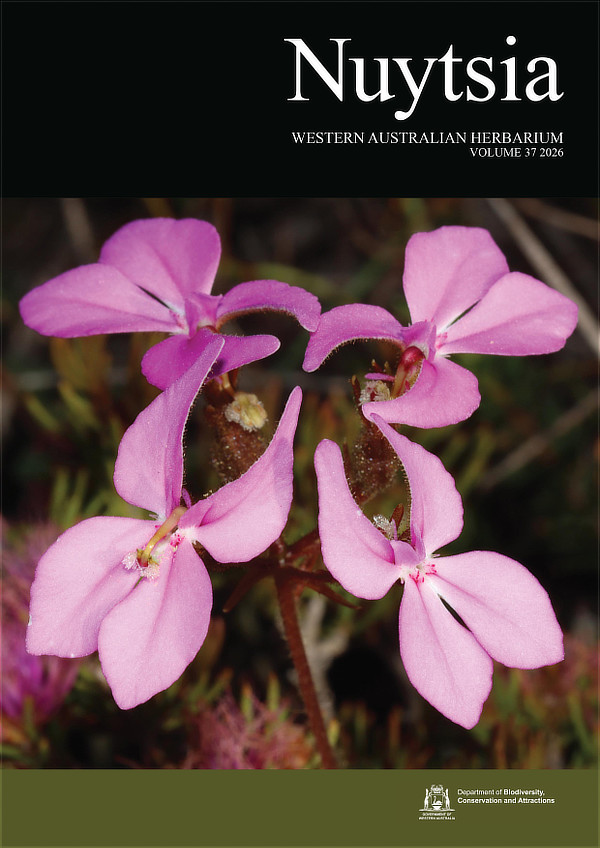
The Western Australian Herbarium’s collections management system, WAHerb, and DBCA’s flora taxonomic names application, WACensus, have been set to read-only mode since 1 October 2025. Recent taxonomic changes are not currently being reflected in Florabase, herbarium collections, or the census. The project team is now conducting testing of the migrated data, and a further update will be provided by the end of the financial year (1 July). Please reach out to us if you have any questions or concerns.
The notice period
started at 9:45 am on Friday, 12 December 2025 +08:00 and will end at 12:00 pm on Wednesday, 1 July 2026 +08:00.
Eucalyptus calyerup McQuoid & Hopper is described and illustrated. It appears to be of possible hybrid origin, but morphologically stable, with the putative parents being Eucalyptus occidentalis Endl. and E. platypus Hook. subsp. platypus. It is endemic to the Calyerup Rocks area near Jerramungup in Western Australia and has aroused much interest from landcare groups. It is rare in the wild and in need of monitoring.
A revision of Eucalyptus series Calcicolae (Myrtaceae) from the south coast of Western Australia
Eucalyptus series Calcicolae Brooker consists of four closely related taxa, two of which are newly described. E. calcicola Brooker subsp. calcicola is restricted to the Hamelin Bay area on the Leeuwin Coast, and subsp_. unita_ Nicolle subsp. nov. occurs in scattered populations from west of Denmark eastwards towards Bremer Bay. E. ligulata Brooker subsp. ligulata occurs from Cape Le Grand to Cape Arid, and subsp. stirlingica Nicolle subsp. nov. is restricted to the Stirling Range. A key and distribution map for the taxa of Eucalyptus ser. Calcicolae are presented.
Two new species of silver mallet (Eucalyptus - Myrtaceae) of very restricted distribution in south-western Western Australia
Eucalyptus rugulata Nicolle sp. nov. is described from the South Ironcap-Hatter Hill area north-east of Lake King, distinguished within the silver mallets by its broad and thick adult leaves and the large and robust buds and fruits. E. purpurata Nicolle sp. nov. is described from a single population near Bandalup Hill east of Ravensthorpe. It is distinguished from E. argyphea L.A.S. Johnson & K.D. Hill by the conspicuous red-purple new growth and the smaller buds and fruits. Both new species are of restricted distribution and E. purpurata, in particular, is considered to be at risk. A key and distribution map for the silver mallets are presented.
One new Banksia and two new Grevillea species (Proteaceae: Grevilleoideae) from Western Australia
OLDE, PETER M. AND MARRIOTT, NEIL R., Nuytsia15 (1): 85–99 (2002)
Banksia rosserae P. Olde & N. Marriott, a new species of Banksia R. Br., Grevillea kirkalocka P. Olde & N. Marriott and G. squiresae P. Olde & N. Marriott, two new species of Grevillea R. Br. (Proteaceae: Grevilleoideae) are described. Their affinities are discussed and keys are provided. All of the new species have conservation priority.
A revision of the south-western Australian species of Micromyrtus (Myrtaceae) with five antisepalous ribs on the hypanthium
Among the species currently included in Micromyrtus Benth., two main categories are distinguished here on the basis of hypanthium ribbing, one characterised by having antipetalous ribs and usually also antisepalous ones, the other by having antisepalous ribs but no antipetalous ones. Most species belong to the latter category, including the lectotype selected here for the genus, Micromyrtus drummondii Benth. nom. superfl. [= M. obovata (Turcz.) J.W. Green]. A key is given to the 14 Western Australian members of this group, and the eight south-western species, including five new species, are revised. Micromyrtus erichsenii Hemsl. is reinstated and the new species M. monotaxis Rye, M. ninghanensis Rye, M. papillosa J.W. Green ex Rye, M. rogeri J.W. Green ex Rye and M. uniovula Rye are illustrated. Three of these new species have an ovule number of one, lower than any previously recorded for the genus, and four of them have conservation priority.
Scaevola ballajupensis (Goodeniaceae), a new species from the Jarrah forest of south-western Australia
The new species Scaevola ballajupensis L.W. Sage, from the south-western Australian Jarrah forest, is described and photographically illustrated. The species is known only from one locality on private property and therefore has a high conservation priority. An amendment to the key to Scaevola species in "Flora of Australia" is made to include the new taxon and a table showing how it differs from its closest relatives is provided.
A revision of Hibbertia depressa and its allies (Dilleniaceae) from Western Australia
A small group of closely related taxa, which form part of section Candollea Gilg. in the genus Hibbertia Andr., are revised. Descriptions, illustrations and distribution maps are presented along with a key, including two new taxa, Hibbertia fitzgeraldensis J.R. Wheeler and Hibbertia priceana J.R. Wheeler. Both new species are restricted in distribution and Hibbertia priceana appears to be at risk. The lectotypification of Hibbertia desmophylla (Benth.) F. Muell. is also made.
Miscellaneous new species of Hibbertia (Dilleniaceae) from the wheatbelt and pastoral regions of Western Australia
The new taxa, Hibbertia ancistrophylla J.R. Wheeler, H. ancistrotricha J.R. Wheeler, H. avonensis J.R. Wheeler, H. lepidocalyx J.R. Wheeler, H. lepidocalyx subsp. tuberculata J.R. Wheeler and H. stenophylla J.R. Wheeler are described, mapped and illustrated. All belong to either section Pleurandra (Labill.) Benth. or section Hemipleurandra Benth. They are recorded from the Avon Wheatbelt, Jarrah Forest and Mallee regions of the South West Botanical Province and the Coolgardie, Murchison and Yalgoo regions of the Eremaean Province.
Lectotypification of two Western Australian species of Micromyrtus (Myrtaceae)
Among the species of Micromyrtus Benth. (Myrtaceae) that Bentham (1867) described in "Flora Australiensis", were two Western Australian species that had previously been recognised as distinct taxa by Ferdinand von Mueller. One had been described as Thryptomene elobata (Mueller 1864) and another had been given the manuscript name T. racemosa F. Muell. The purpose of this short communication is to select a lectotype from among the syntypes of each of these species.
Eucalyptus conglobata subsp. perata (Myrtaceae), a new taxon from southern Western Australia and notes on E. series Rufispermae
BROOKER, M.I.H. AND SLEE, A.V., Nuytsia15 (2): 157–162 (2004)
A new taxon, Eucalyptus conglobata R. Br. ex Maiden subsp. perata Brooker & Slee, from southern Western Australia is described and illustrated. A distribution map for the typical and the new subspecies is provided. A brief discussion of the large E. series Rufispermae to which the species belongs is given.
New species and lectotypifications of some reticulate-nerved Tephrosia (Fabaceae) from north-west Australia and the genus Paratephrosia re-evaluated
Eight new species of reticulate-nerved Tephrosia are described from the Kimberley Region of Western Australia and the Northern Territory (T. andrewii Cowie, Tephrosia bifacialis Cowie, T. carriemichelliae Cowie, T. ephippioides Cowie, T. gyropoda Cowie, T. humifusa Cowie, T. procera Cowie, and T. valleculata Cowie). Paratephrosia is reduced to synonymy under Tephrosia and a new name, Tephrosia lasiochlaena Cowie, is published for P. lanata. Lectotypifications are provided for six reticulate-nerved and allied taxa of Tephrosia (T. flammea F. Muell. ex Benth., T. nematophylla F. Muell., T. oblonga R. Br. ex Benth., T. polyzyga F. Muell. ex Benth., T. porrecta R. Br. ex Benth. and T. reticulata R. Br. ex Benth.).
Grevillea bipinnatifida subsp. pagna (Proteaceae), a new subspecies from south-west Western Australia
Restricted to the Swan Coastal Plain of Western Australia, Grevillea bipinnatifida subsp. pagna Cranfield is described. Leaf variation within Grevillea bipinnatifida is also illustrated.
A list of known lichen taxa for Western Australia is presented; family, genus, species and infra species are listed with authors and reference to original publication. Biogeographic regions are indicated for each species based on the collections of the Western Australian Herbarium. A table giving statistical data for families and genera is included.
Two new species of Ptilotus (Amaranthaceae) from Western Australia
Two new species of Ptilotus (Amaranthaceae) from the central and southern regions of Western Australia are described: Ptilotus chrysocomus R.W. Davis, known from one location near the Carnarvon Range in the vicinity of the abandoned Blue Hill Station, Little Sandy Desert; and Ptilotus halophilus R.W. Davis, known from the margins of Lake Altham and from Lake Hurlstone Reserve in the Lake Grace to Pingrup and Holt Rock to Hyden areas.
Eucalyptus virginea and E. relicta (Myrtaceae), two new rare forest trees from south-western Australia allied to E. lane-poolei, and a new phantom hybrid
HOPPER, STEPHEN D. AND WARDELL-JOHNSON, G., Nuytsia15 (2): 227–240 (2004)
Eucalyptus virginea and E. relicta are described from Mt Lindesay National Park and from the Whicher Range south-east of Busselton respectively. Both species, together with E. lane-poolei, are in the earliest branching clade of E. ser. Curviptera, which contains many horticulturally attractive large-flowered mallees from semi-arid and desert regions such as E. macrocarpa and E. youngiana. The discovery and description of these two rare relictual forest trees so recently highlights the need for ongoing botanical survey of south-western Australia’s forests. A phantom hybrid, Eucalyptus lane-poolei × relicta, is also described for the first time. It occurs close to populations of E. relicta in the Whicher Range but 150 km south of the nearest recorded E. lane-poolei.
A new species of Bulbine (Asphodelaceae) from Western Australia
A new species of Bulbine Wolf, B. pendula Keighery, is described and illustrated. The species is confined to cracking clay wetlands in the Pilbara, Carnarvon, Ashburton and Great Sandy Desert Biogeographical Regions of arid Western Australia.
A taxonomic review of the genus Agrostocrinum (Phormiaceae)
The genus Agrostocrinum F. Muell. is reviewed. Two species are recognised, A. hirsutum (Lindl.) Keighery and A. scabrum (R. Br.) Baillon, both confined to southern Western Australia. A distinctive inbreeding maritime race of the latter, found in scattered populations on granites along the south coast, is described as a new subspecies, A. scabrum subsp. littorale Keighery.
Taxonomic notes on the Angianthus drummondii complex (Asteraceae : Gnaphaliinae)
Angianthus drummondii is revised and shown to be a species complex of three allopatric species. The complex comprises A. drummondii (Turcz.) Benth., an erect plant with long inflorescence bracts confined to fresh water clay-based wetlands; A. platycephalus Benth., a prostrate plant with short broad inflorescence bracts, growing in fresh to brackish clay soils, is resurrected; and a new species A. halophilus Keighery, an erect plant with short inflorescence bracts, found on gypsum soils, is described.
Taxonomy of the Calytrix ecalycata complex (Myrtaceae)
The part of the genus Calytrix Labill. that was formerly regarded as the monotypic genus Calythropsis C.A. Gardner is shown to be composed of two allopatric species, Calytrix ecalycata Craven and C. pimeleoides C.A. Gardner ex Keighery. The former species is comprised of three geographically separated subspecies, C. ecalycata subsp. ecalycata, C. ecalycata subsp. brevis Keighery and C. ecalycata subsp. pubescens Keighery.
Two new species of Dampiera (Goodeniaceae) from the Pilbara region, Western Australia
LEPSCHI, B.J.,TRUDGEN, MALCOLM E. AND VAN LEEUWEN, S., Nuytsia15 (2): 269–276 (2004)
Dampiera anonyma and Dampiera metallorum Lepschi & Trudgen, two geographically restricted taxa from the Pilbara region of Western Australia, are described, illustrated and their distributions mapped.