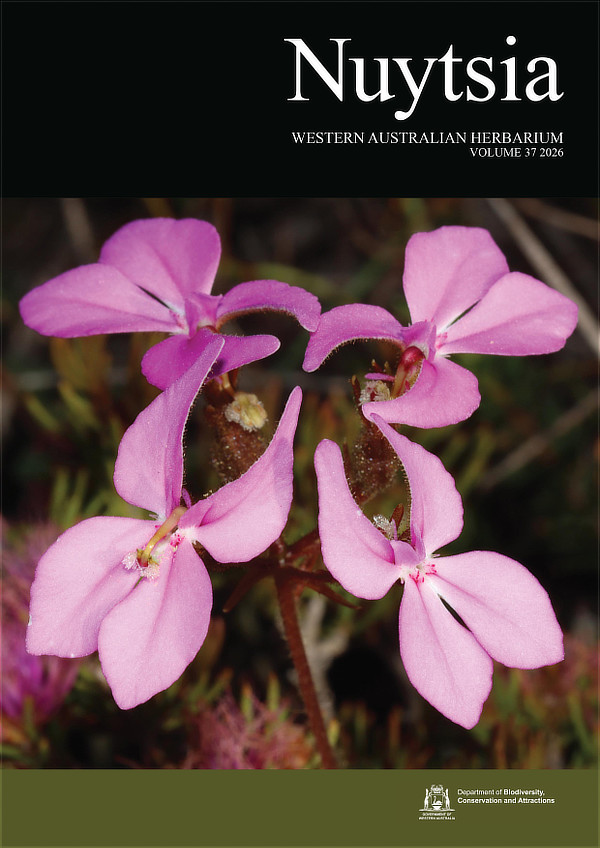
The Western Australian Herbarium’s collections management system, WAHerb, and DBCA’s flora taxonomic names application, WACensus, have been set to read-only mode since 1 October 2025. Recent taxonomic changes are not currently being reflected in Florabase, herbarium collections, or the census. The project team is now conducting testing of the migrated data, and a further update will be provided by the end of the financial year (1 July). Please reach out to us if you have any questions or concerns.
The notice period
started at 9:45 am on Friday, 12 December 2025 +08:00 and will end at 12:00 pm on Wednesday, 1 July 2026 +08:00.
A new species of Wurmbea, W. fluviatilis T.Macfarlane & A.Case, is described and illustrated with photographs and a distribution map. The new species is known from only three populations from the Gascoyne River catchment in the region of Mount Augustus, growing on river banks and beside riverside pools. It is a relatively tall, attractive species with bi-coloured flowers.
Valid publication of Ptilotus stirlingii subsp. australis (Amaranthaceae)
DAVIS, R.W. AND BUTCHER, R., Nuytsia21 (1): 31–32 (2011)
In an oversight in a paper (Davis & Butcher 2010) resolving the status of infraspecific taxa in Ptilotus stirlingii (Lindl.) F.Muell. the Latin diagnosis for the new subspecies Ptilotus stirlingii subsp. australis R.W.Davis & R.Butcher was omitted, thereby rendering the name invalidly published under the International Code of Botanical Nomenclature. This omission is rectified here, and the new subspecies formally described.
Removal of the informal name Epiblema grandiflorum var. cyaneum ms from the Census of Western Australian Plants
While conservation of unusual variants of any plant species is desirable, taxonomic recognition of such variants is not warranted unless evidence is available that they represent genetically distinct evolutionary lineages. Geographically restricted variants such as E. grandiflorum var. cyaneum ms are no more likely to warrant taxonomic recognition than widespread and common variants. Removal of Epiblema grandiflorum var. cyaneum ms from the Census of Western Australian Plants is recommended.
New south-western Australian members of the genus Petrophile (Proteaceae: Petrophileae), including a hybrid
Four additional species are recognised in the genus Petrophile R.Br. ex J.Knight by the reinstatement of P. axillaris Meisn. and the description of three new species, P. globifera Hislop & K.A.Sheph., P. foremanii Hislop & Rye and P. septemfida Rye & K.A. Sheph. A hybrid between P. ericifolia R.Br. and P. seminuda Lindl. is documented, the new subspecies divaricata Hislop & K.A.Sheph. is named for P. conifera Meisn., and a lectotype is selected for P. seminuda var. indivisa Benth. There is also a key for members of the genus occurring in Western Australia, excluding those belonging to Petrophile sect. Arthrostigma (Endl.) Kuntze.
Stackhousia stratfordii (Celastraceae: Stackhousioideae), a remarkable new species from a remote location near Norseman, south-west Western Australia
BARKER, W.R. AND COCKERTON, G.T.B., Nuytsia21 (2): 69–74 (2011)
Stackhousia stratfordii W.R.Barker & Cockerton sp. nov. possesses attributes unique to its genus and subfamily of opposite sub-radical leaves and flowers borne in scapes and containing three stamens. Morphological evidence is summarised arguing its placement within Stackhousia . The Stackhousioideae Burnett are a subfamily distinctive in Celastraceae R.Br. for their herbaceous life-form, mainly moth-pollinated, tubular flowers, and fruits that are single-seeded indehiscent mericarps (cocci) (Barker 1983, 1984, in press); in terms of diversity they are centred in Australia, occurring in much of the continent, in temperate arid, semi-arid and sub-tropical regions. Until recently a separate family (Stackhousiaceae R.Br.), the subfamily has morphological and geographic features unique in the family Celastraceae, in which they have been placed in the last decade (Kubitzki 2004a, b; Simmons 2004 a, b). It comprises three genera: Tripterococcus Endl. with three species , confined to south-west Western Australia, Macgregoria F.Muell., a single species spread across the southern half of arid Australia, and Stackhousia Sm. with over 30 species spread over the geographical and climatic range of the subfamily in Australia, with a single species in New Zealand and another spread into Malesia, the Philippines and Micronesia (Barker, in press).
New, locally endemic taxa in Leucopogon (Ericaceae: Styphelioideae: Styphelieae) from the Perth and midwest regions of Western Australia
Four new taxa, Leucopogonmaritimus Hislop, L. nitidus Hislop, L. stokesii Hislop, and L. squarrosus Benth. subsp. trigynus Hislop are described and mapped; the first three are illustrated. All have very restricted distributions and are of high conservation priority. Lectotypes for L. squarrosus and L. brachycephalus DC. var. heterophyllus Sond. are designated.
Labichea rossii (Fabaceae: Caesalpinioideae), a new species from the Yilgarn Ranges, Western Australia
A new rare species of Labichea Gaudich. ex DC. is described from a ridge of Banded Iron Formation in the ranges near Mt Holland. Unlike most species in the genus, this new species, L. rossii N.Gibson, has very dissimilar petals more reminiscent of flowers from subfamily Faboideae.
A new and rare species of Ptilotus (Amaranthaceae) from a suburban wetland of the eastern Swan Coastal Plain, Western Australia
DAVIS, R.W. AND TAUSS, C., Nuytsia21 (3): 97–102 (2011)
Ptilotus christineae R.W.Davis & Tauss, currently known from only one small population in the Greater Brixton Street Wetlands, about 14 km from the centre of the city of Perth, is described and illustrated. A key to Ptilotus R.Br. of the Swan Coastal Plain Biogeographical Region is provided.
An assessment of some infraspecific taxa in Ptilotus (Amaranthaceae) from Western Australia
This paper deals with three infraspecific taxa in Ptilotus that do not warrant recognition: Ptilotus appendiculatus Benl var. minor Benl, Ptilotus divaricatus (Gaudich.) F.Muell. var. rubescens Benl and Ptilotus lanatus Cunn. ex Moq. var. glabrobracteatus Benl.
A revision of Dielsiodoxa (Ericaceae: Styphelioideae: Oligarrheneae)
ALBRECHT, D.E. AND HISLOP, M., Nuytsia21 (3): 107–126 (2011)
The genus Dielsiodoxa Albr., endemic to south-west Western Australia, is revised. The genus includes three previously named species, D. leucantha (E.Pritz.) Albr., D. oligarrhenoides (F.Muell.) Albr. and D. tamariscina (F.Muell.) Albr. A neotype is designated for the former species and a lectotype for the latter species. Three new taxa are described with accompanying scanned images: D. lycopodioides Albr., D. propullulans Albr. and D. leucantha subsp. obtusa Hislop & Albr. Descriptions, a distribution map and a key to all taxa are provided.
Sida picklesiana (Malvaceae), a new species from the Murchison-Gascoyne region of Western Australia
This article provides a description of the recently discovered species Sida picklesiana A.S. Markey, S.J. Dillon & R.M. Barker. This species is known from an area near Wiluna in Western Australia’s Murchison-Gascoyne region, where it occurs in a variety of habitats. Sida picklesiana has conservation priority status as it has a relatively limited distribution. Major differences between Sida picklesiana and the species with which it is most likely to be confused are discussed, and the most recently published draft key to Sida is amended to include this new species.
Two species of Inocybe (fungi) introduced into Western Australia
BOUGHER, N.L. AND MATHENY, P.B., Nuytsia21 (3): 139–148 (2011)
This paper reports for the first time the introduction into Western Australia from the northern hemisphere of Inocybe curvipes P.Karst. and Inocybe rufuloides Bon. The fungi are associated with planted non-native ectomycorrhizal trees – Quercus, Pinus, and possibly Salix. Previously, I. curvipes was confirmed from South Australia where it has been present for at least almost a century, but it was not known from Western Australia. I. rufuloides had not been recorded anywhere in Australia. In this paper I. curvipes is also reported for the first time in Papua New Guinea, in association with planted Quercus and Pinus. Populus and Quercus are confirmed as ectomycorrhizal partners of I. curvipes based on ITS BLASTn analysis of environmental sequences.
Eremophila koobabbiensis (Scrophulariaceae), a new, rare species from the wheatbelt of Western Australia
CHINNOCK, R.J. AND DOLEY, A.B., Nuytsia21 (4): 157–162 (2011)
Eremophila koobabbiensis Chinnock, sp.nov., is described and illustrated. This rare species is known only from one area north of Moora and its conservation is discussed. It is also established in cultivation and its long-term survival is assured.
A reinstatement and a new combination in Leucopogon (Ericaceae: Styphelioideae: Styphelieae)
The group of species synonymised by Bentham (1868) under Leucopogonrevolutus R.Br. are re-examined and found to be heterogeneous. As a result L. rubricaulis R.Br. is reinstated. Two morphotypes identified within L. obovatus (Labill.) R.Br. (erroneously treated by Bentham as L. revolutus) are described as subspecies and the combination L. obovatus (Labill.) R.Br. subsp. revolutus (R.Br.) Hislop is here published. Descriptions and illustrations are provided for the three taxa treated and their distributions are mapped.Lectotypes are designated for L. capitellatus DC. var. sparsiflorus Sond., L. revolutus, L. rubricaulis and L. villosus R.Br.
Amanita ochroterrea and Amanita brunneiphylla (Basidiomycota), one species or two?
Amanita ochroterrea (Gentilli) Bas and A. brunneiphylla O.K.Miller are robust, macroscopically similar mushrooms described from the southwest of Western Australia. According to the protologue of A. brunneiphylla, the main difference between them is the presence (in A. ochroterrea) or absence (in A. brunneiphylla) of clamp connections. However in the current study abundant clamp connections have been observed in the holotype and paratypes of A. brunneiphylla. As other microscopic characters are indistinguishable, A. brunneiphylla is synonymised with A. ochroterrea, and an expanded description presented.
Two new species from the Leucopogon distans group (Ericaceae: Styphelioideae: Styphelieae) and the reinstatement of L. penicillatus
Two new species, Leucopogon microcarpus Hislop and L. newbeyi Hislop are described and another, L. penicillatus Stschegl., previously reduced by Bentham (1868) to a variety of L. distans R.Br., is reinstated. All three are illustrated and their distributions mapped. A key is provided for all Western Australian taxa currently referred to the L. distans group (sensu Hislop & Chapman 2007). Lectotypes are designated for L. distans and L. reflexus R.Br. Taxonomic and nomenclatural notes pertaining to L. atherolepis Stschegl.and L. reflexus are also included.
Two new mallee box species (Eucalyptus sect. Adnataria ser. Lucasianae; Myrtaceae) from the Pilbara region of Western Australia
NICOLLE, D. AND FRENCH, M.E., Nuytsia22 (1): 17–29 (2012)
Two new species are described, both which have previously been included in E. lucasii Blakely, viz: E. aridimontana D.Nicolle & M.E.French sp. nov., known from high mountain ridges of the Hamersley Range, and E. rowleyi D.Nicolle & M.E.French sp. nov., known from plains of the De Grey River catchment to the north-east of the Hamersley Range. Both species differ from E. lucasii in their adult leaves which age to green and/or glossy, and in their thickened pedicels and peduncles (among other characteristics). Eucalyptus lucasii, as now circumscribed, is a widespread species restricted to watercourses and flood-out plains south of the Pilbara region. A key to E. ser. Lucasianae Chippend. and distribution maps for E. lucasii, E. aridimontana and E. rowleyi are provided.
A new species of Gompholobium (Fabaceae: Mirbelieae) from the Pilbara bioregion of Western Australia
WILKINS, C.F. AND TRUDGEN, MALCOLM E., Nuytsia22 (1): 31–40 (2012)
Gompholobium oreophilum C.F.Wilkins & Trudgen, a new species from the Pilbara bioregion of Western Australia, is described and compared to its close relatives G. karijini Chappill and G. polyzygum F.Muell. The different habitat preferences and the possible hybridisation between G. oreophilum and G. karijini, which is also endemic to the Pilbara, are discussed. A key and distribution maps are provided.
Leucopogon navicularis (Ericaceae: Styphelioideae: Styphelieae), another local endemic from the midwest region of Western Australia
Acacia bartlei Maslin & J.E.Reid, a new, rare species of Acacia Mill. related to A. redolens Maslin, is described. It is restricted to a small area north and north east of Esperance, Western Australia, where it grows in often waterlogged depressions.